

 Vendor Portal

Author: Mark Ainely | Partner GC Realty & Development & Co-Host Straight Up Chicago Investor Podcast
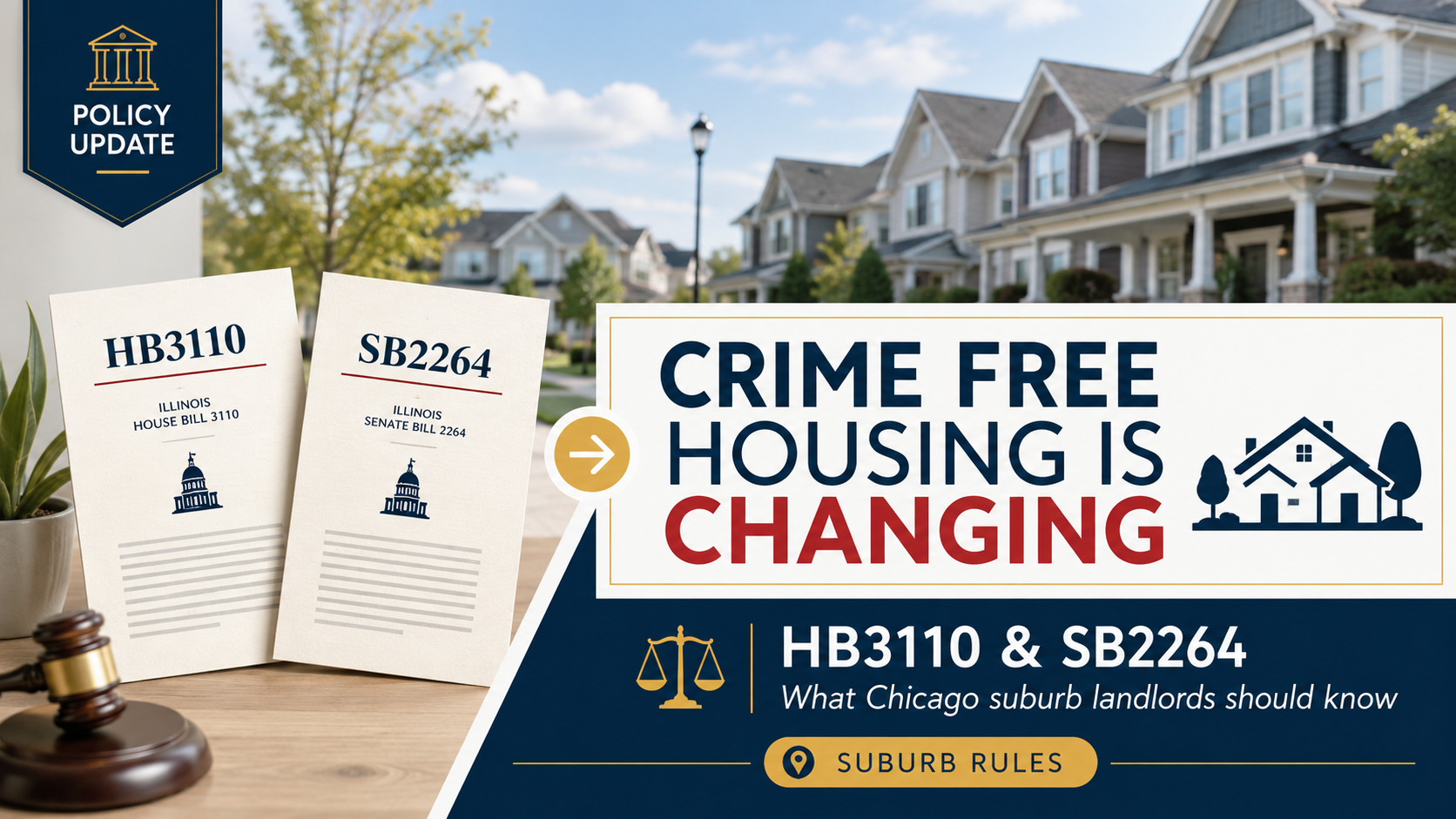
I kept seeing suburbs around Chicago talk about changing their crime free housing programs. So I looked into why. The trail led me to two bills out of Springfield that no one is talking about. They are called HB3110 and SB2264.
Here is the part that surprised me. Neither bill ever passed. But the proposal alone, and all the talk around it, has already started changing how some Chicago suburbs run their crime free programs. Suburbs like Richton Park and Barrington have already made moves. So even though nothing became law, the effect is real. Let me walk you through it in plain words. I will tell you what each bill says, where it stands today, and what it means for you if you own rentals in the Chicago area.
Key Takeaways
HB3110 and SB2264 are two Illinois bills from 2025 that would limit local crime free housing rules.
Neither bill has passed. Both stalled in committee in the spring of 2025 and have not moved since.
The bills would stop suburbs from punishing tenants just for calling the police or for past contact with law enforcement.
Even with the bills stalled, suburbs like Richton Park and Barrington have already started changing their crime free programs.
If you own rentals, the lease and screening rules you lean on may shift, so it pays to know what is coming.
First, What Is Crime Free Housing?
Crime free housing is a local program. Many suburbs in Illinois have one. The idea sounds simple. The suburb wants to keep crime out of rental homes. So it asks landlords to add a crime free lease addendum. It can also ask landlords to evict a tenant when the police flag a problem.
Here is a fun bit of history. Crime free housing did not even start in Illinois. It was born in the desert. Police in Mesa, Arizona built the very first crime free housing program back in 1992. The idea spread fast. It reached Illinois in the 1990s, and it really took off here after the year 2000. That is when Chicago started tearing down the old Cabrini Green housing project. Suburbs nearby worried about where those renters would go, so dozens of them rushed to start their own crime free programs. More than 100 Illinois communities ended up adopting the rules. Today about one in four people in Illinois live somewhere with a crime free or nuisance rule on the books. So this has been part of Illinois life for around 30 years now.
For years a lot of owners saw these programs as helpful. But over time, reporters and tenant groups found problems. A 2025 investigation by The New York Times and the Illinois Answers Project showed families getting evicted for very small things. In some cases people were pushed out for calling 911 too many times. In other cases people were pushed out for a crime they did not even commit.
Critics say the programs hit low income families and people of color the hardest. They also say the rules can punish victims of domestic violence who simply needed help. Supporters, like the Illinois Crime Free Association and some police chiefs, say the programs help clean up troubled buildings and protect neighborhoods. That fight is what led to these two bills.
A lot of this traces back to one lawsuit. A woman named Diamond Jones rented a home in Richton Park, a south suburb of Chicago. She got a notice telling her to move out in 10 days. The village said she broke its crime free rule. The catch is, she was never even charged with a crime. She fought back and sued the village in federal court. She later won a settlement worth about 250,000 dollars. After that, Richton Park changed its crime free ordinance. That case got the attention of housing groups across the state, and the push to limit these rules took off from there. In many ways, one tenant and one lawsuit are what started this whole conversation.
What HB3110 Would Do
HB3110 is the House bill. Representative Jennifer Gong-Gershowitz filed it in February 2025. It would change the Counties Code and the Illinois Municipal Code. In plain terms, it would stop suburbs and counties from running crime free housing rules that go too far.
Here is what the bill would block a suburb from doing:
Punishing a tenant, owner, or landlord just because someone had contact with the police or called for emergency help.
Forcing a landlord to evict a tenant based on criminal history.
Treating a 911 call or a request for help as a nuisance.
Making a tenant get a certificate of occupancy just to move in or turn on utilities.
Keeping a tenant registry meant to keep certain people out of housing.
The bill would also let people take a suburb to court over a rule like this. Notice one thing here. Those lawsuits would target the suburb or county. They would not target individual landlords.
What SB2264 Would Do
SB2264 is the Senate version. It covers a lot of the same ground. It also adds something extra. A suburb that keeps a crime free program would have to set up an Office of the Crime Free Housing Coordinator.
That coordinator would have rules to follow. The person would need at least three years of experience in social work or community advocacy. They would also need fair housing training, including training on helping domestic violence survivors and people with disabilities.
Under this bill, any tenant who gets a notice to quit over a crime free or nuisance rule would be sent to that coordinator. The coordinator would review the case. The tenant would also get the right to challenge the action in court.
Where These Bills Stand Right Now
This is the part most owners get wrong. Neither bill is law.
HB3110 was sent back to the Rules Committee in March 2025 and stopped there. SB2264 went a little further. It cleared a Senate committee in May 2025, but only with support from one party. Then it was sent back to Assignments in June 2025 and has not moved since.
So as of now, nothing has changed at the state level. Both bills are stalled.
Why This Still Matters Even Though The Bills Stalled
You might think you can ignore all of this. I would not. Here is why.
The issue is not going away. The reporting that started this is still out there. Tenant groups are still pushing. A bill that stalls one year can come right back the next.
Many suburbs are not waiting for the state. Some Chicago area suburbs are already changing their crime free programs on their own. Richton Park amended its ordinance after that lawsuit. Barrington is going a step further. It is looking to replace its old crime free rules with what it calls a Rental Housing Tenant Protection Program. The focus moves away from criminal activity and toward tenant rights, fair housing, and code standards. The reason is simple. If a state law does pass later, a program that has already shifted is less likely to get struck down. That is close to the exact reason Barrington gave for making the change now.
Fair housing risk is real right now. With or without these bills, the rules are tightening. The Illinois Department of Human Rights put out a guidebook with the UIC Law School. It helps suburbs make sure their crime free and nuisance rules do not break fair housing law. That tells you where the state is leaning, even without a new statute.
What This Means For You As A Chicago Area Rental Owner
Let me bring this back to your building. Here is what I would do.
Know your local program. Crime free rules are local, not statewide. The rules in one suburb can look nothing like the rules in the next. Check what your suburb actually requires before you rely on it.
Be careful with your lease addendum. If your suburb has a crime free addendum, do not treat it as bulletproof. The legal ground under it is shifting.
Never punish a tenant for calling for help. This is the heart of both bills, and it is also just good practice. If a tenant calls the police because they are in danger, that is not a reason to start an eviction.
Lead with fair housing. When you screen and when you handle problems, fair housing law is your guide. Both bills and the state guidebook all point the same way.
When in doubt, get help. These rules change fast and they change by suburb. Across the roughly 1,500 units we manage in Chicagoland, we watch these local rules closely so owners do not get caught off guard. A good property manager who works across the whole market sees these shifts early and adjusts before they become a problem.
Frequently Asked Questions
Did HB3110 or SB2264 pass?
A: No. Both stalled in committee in 2025 and have not moved since. Neither one is law.
Do these bills add a rental license for landlords?
A: No. Neither bill creates a rental license or a landlord registration. They limit how suburbs can run crime free housing rules.
Would these bills let tenants sue me?
A: HB3110 lets people sue the suburb or county over a bad rule. It does not target individual landlords for that claim.
My suburb has a crime free program. Is it going away?
A: Not automatically. Nothing at the state level forces a change yet. But some suburbs are updating their programs on their own, so check with your suburb.
Do I still need to follow my suburb’s crime free program rules?
A: Yes. If your suburb has a crime free program on the books, it is still the law there, and you still have to follow it. Nothing changed at the state level, because neither bill passed. So if your suburb requires a crime free lease addendum, a rental license, or landlord training, keep doing all of it. The smart move is to follow the rules but enforce them with care. Lean on fair housing law, write down what you do, and never punish a tenant just for calling for help.
What should I do right now?
A: Know your local rules, keep your screening and lease practices in line with fair housing law, and never penalize a tenant for calling for emergency help.
Will This Ever Become Law?
Now let me give you my honest opinion. I think some version of this will pass one day. The pressure keeps building, and these issues do not just go away. So I would plan on it.
But I would not hold my breath for this year. Springfield has been pretty consumed with the Chicago Bears and their stadium fight lately. When lawmakers are busy chasing a stadium deal, smaller housing bills like these two tend to sit on the shelf.
Here is the bigger thing, though. Even if the law does pass, I am not sure it will push suburbs to change as fast as you might think. Look at what actually moved the needle so far. It was not a new law. It was the lawsuit in Richton Park. One tenant won a settlement, and all of a sudden, the suburbs started paying attention and changing their rules. In my experience, the fear of a lawsuit moves a city a lot faster than a new line in the state code ever will.
So my advice stays the same. Do not wait on Springfield. Watch how your own suburb handles this, keep your practices clean, and lean on fair housing right now.
Don’t Go At This Alone!
We’ve shared a lot of information here on investing in real estate locally in Chicagoland. If you live outside the area, it may seem overwhelming for those wanting to invest in the Chicago market. But we view it as a team sport.
Who’s on your investing team? Do you even have a team? GC Realty & Development, LLC has a dedicated team of professionals with decades of experience across all facets of real estate investment. We handle everything from brokerage to leasing and property management. Whether you hire us or not, we’re happy to provide our resources and expertise.
What gets me up in the morning and keeps me going for 12 hours a day is the ability to add value for local area investors in Chicago and beyond! Those who connect with me often hear me say that our goal is to bring value to everyone we come in contact with.
In return, they will one day hire us for our tenant placement or property management services, refer us to someone they know, or leave a review about our services. We would clearly love all three; however, we’re happy whenever we get the opportunity to help!
 (3)_21.png)