

 Vendor Portal

Author: Mark Ainely | Partner GC Realty & Development & Co-Host Straight Up Chicago Investor Podcast
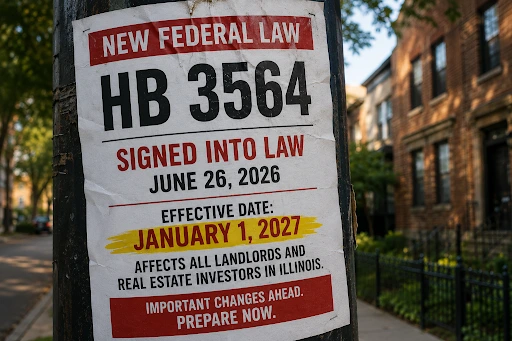
HB 3564, the amendment to the Illinois Landlord and Tenant Act adding rental fee transparency and limitations provisions, was signed into law by Governor Pritzker on June 26, 2026. You can read the full text and bill status of HB 3564 on the Illinois General Assembly website if you want to go straight to the source. The Chicagoland real estate industry now has to dissect what changes must be made to the current way of doing business. This goes into effect January 1, 2027, and it applies to all landlords and real estate investors in Illinois. This is not just a Chicago or Cook County thing. This affects investors in Naperville, Woodstock, and Addison just as much as it affects investors on the North Side.
This law does not stop at landlords. Property managers, Realtors, and real estate firms across Illinois are all directly affected, since the disclosure requirements reach into listings, marketing, and leasing activity, not just lease signing. If you write listing copy, advertise a rental, screen an applicant, or manage a lease on behalf of an owner, this applies to you.
Key Takeaways
HB 3564 was signed June 26, 2026. A companion trailer bill, HB 5234, moved the effective date from July 1, 2026 to January 1, 2027, giving landlords a full lease cycle to prepare.
This is a statewide law that amends the Landlord and Tenant Act. It applies everywhere in Illinois, not just Chicago or Cook County.
All non optional fees, whether one time or recurring, must be disclosed on the first page of the lease and in any listing or advertisement that includes the rent amount.
If a fee is not explicitly listed on the first page of the lease, the tenant is not liable for it.
The enacted law bans eleven specific fee types outright, covering everything from application fees over $50 to fees for maintenance hotlines, travel to complete repairs, and move-in or move-out walkthroughs.
Owner-occupied properties with 6 units or fewer are exempt from this law entirely.
The final enacted version does not include a move-in fee cap or a security deposit cap. Earlier drafts of the bill proposed both, but that language was replaced before passage.
The enforcement mechanism is a private right of action. A tenant can sue for injunctive relief, monetary damages, and attorney's fees.
Why This Is Not Just a Chicago Problem
Because HB 3564 amends the state Landlord and Tenant Act rather than a city ordinance, it does not care where your property sits. A landlord with a single family rental in Naperville, a small multifamily building in Woodstock, or a portfolio of units in Addison is under the exact same rules as an owner on the North Side of Chicago. This law applies statewide, and it means every suburban investor needs to treat this with the same urgency as an owner downtown. Being a landlord in Kane and DuPage County is starting to come with more and more regulation, and up until recent years it has been the Wild West compared to doing business in Chicago proper. We covered this shift in more detail in our piece on what this law means for landlords across the region.
Who Is Exempt
The enacted law does carve out one exemption, and it is a narrow one. HB 3564 does not apply to lease agreements for dwelling units in owner-occupied premises containing 6 units or fewer. If you live in the building and it has 6 units or fewer, this law does not reach that property.
Two things worth being precise about. First, this is an owner-occupied exemption, not a small-portfolio exemption. If you own a 6 unit building but do not live in it, the exemption does not apply. It is tied to the owner actually residing on the property, not just the unit count. Second, this exemption is specific to HB 3564 itself. It does not exempt you from local ordinances like Chicago's RLTO or Cook County's RTLO, which have their own separate small-owner-occupied carve outs with their own specific rules. Check both the state exemption and whatever local ordinance applies to your property, since they are not the same test.
If you manage a mixed portfolio, this means you could have some properties fully covered by HB 3564 and others exempt, depending on whether you live there and how many units are in the building. That is worth mapping out property by property rather than assuming one answer applies across your whole portfolio.
Do Existing Leases Need To Be Modified?
No, and this is worth understanding clearly so you do not overcorrect. HB 3564 applies to lease agreements entered into after the effective date of January 1, 2027. It does not reach back and rewrite leases that are already signed and in force before that date. If a tenant is currently on a lease that was signed in 2026, that lease does not need to be amended or reissued just because the law changed.
Where this becomes relevant is the next time that lease turns over. A renewal, a new lease with the same tenant, or a new lease with a new tenant signed on or after January 1, 2027 falls under the new rules. That means your active leases do not need to be touched right now, but every lease template, renewal document, and new lease you generate starting January 1, 2027 needs to be compliant. Practically speaking, this gives you a natural cutover point tied to each unit's own lease cycle rather than a single date where every document in your portfolio has to change at once.
One nuance to flag. Since a fee or fine for lease renewal is banned outright, that ban applies to any renewal signed after the effective date, even if the original lease was signed well before HB 3564 existed. The age of the original lease does not matter, what matters is when the renewal itself is executed.
What Changes in the Leasing Process
Here is what changes, step by step, from listing a unit to signing a lease.
Listings and advertisements. Any mandatory fee on top of rent, parking, amenity, technology, or otherwise, must be disclosed in the listing itself or through a clearly accessible link.
Utility disclosure. Every listing and lease must state which utilities are included in the advertised rent and which are not. In practice this is rarely all or nothing, most units have some mix, like water included but gas and electric on the tenant, so the disclosure needs to spell out each utility rather than a blanket yes or no.
No surprise fees after approval. Fees cannot show up for the first time once an applicant has already been approved. Everything has to be known upfront.
First page of the lease. Every non optional fee, one time or recurring, has to live on the first page of the lease agreement. Buried fee schedules in an addendum will not protect you. The exact order of the lease and how all the disclosures need to be laid out on that first page is not 100 percent clear yet, so this is an area to watch as more guidance comes out.
Unenforceable if undisclosed. If a fee is not on page one, the tenant does not owe it.
Marketing and leasing scripts need a review. This is not just a lease document update. Listing platforms, marketing copy, and how leasing staff talk about fees on a showing all need to match what is disclosed.
What Changes on the Revenue Side
This is the part that affects property management companies directly, and when we say property management companies we mean both third party property managers and owners who self-manage their own portfolio. Ancillary fee revenue that many of us have relied on for years is either capped or gone as a pass through line item to the tenant.
Here is the clearest way to break it down. Some fees are banned or capped outright, no matter what you disclose. Others are still allowed, but only if you disclose them properly.
Capped or banned, period, regardless of disclosure:
Application and screening fees above $50, unless you can document the actual third party screening cost was higher, pay it upfront, and bill the tenant within 14 days with a receipt. If you do not bill and provide receipts within 14 days, the fee is waived. This fee also cannot be used as a basis for eviction within the first year of a lease.
Any fee or fine tacked onto the application fee that duplicates screening costs. You can still charge an application fee to cover actual screening costs, you just cannot add a second fee on top of it that does the same job.
Any fee or fine for the modification or renewal of a lease agreement. Modification covers more than renewal itself, it also includes things like adding a roommate to the lease, removing someone from the lease, or any other change to the existing agreement. If you currently charge a lease change fee, an add-a-tenant fee, or a roommate swap fee, that falls under this same ban.
Any fee or fine for an eviction notice or for filing an eviction action, before a court has actually granted an eviction order. This does not stop you from recovering actual court costs and filing fees once you are properly in the eviction process.
Any fee or fine for an after-hours maintenance request. This is about the fee for making the request itself, not about the underlying repair cost. If the tenant caused the damage, you should still be able to bill them back for the actual repair through your normal damage chargeback or security deposit process, you just cannot tack on a separate fee simply because the call came in after hours.
Any fee or fine for contacting the building owner or property manager about maintenance, service requests, lease questions, or anything else directly related to the tenancy.
Any fee or fine for travel required to complete maintenance work or safety repairs.
Any fee or fine for a maintenance hotline service or for calling one, for maintenance, service requests, lease questions, or anything else tied to the tenancy.
Any fee or fine for routine maintenance and upkeep of the unit.
Any fee or fine for pest abatement or removal, when the tenant did not contribute to the infestation.
Any fee or fine for an in-person walkthrough of the unit at move-in or move-out.
Lockout fees. A flat fee for coming to let a tenant in falls under two separate bans here, not just one. It looks like a fee for an after-hours maintenance request when it happens after hours, and separately it looks like a fee for contacting the owner or property manager for a service request related to the tenancy, which has no after-hours qualifier at all. Rekeying is a closer call. If a tenant loses a key and you have to physically rekey the unit, that is a real out-of-pocket cost. The safer structure is billing back the actual locksmith or rekey cost as reimbursement for a tenant-caused expense, rather than charging a flat rekey fee or lockout fee as a line item. Unlike the pest abatement provision, there is no written exception here for when the tenant caused the situation, so do not assume fault changes the analysis.
Still allowed, but only if disclosed on the first page of the lease and in the listing:
Non-refundable move-in fees. The final enacted version of HB 3564 does not cap move-in fees at a percentage of rent. Earlier drafts proposed a 20 percent cap and even an outright ban, but that did not survive to the final law. Move-in fees are still allowed, they just have to be disclosed. This matters a lot in Chicago, where non-refundable move-in fees are commonly used instead of a security deposit specifically to stay outside the RLTO's deposit rules. HB 3564 does not touch that practice. The city's own cap on move-in fees, generally up to 49 percent of one month's rent before it starts looking like a disguised security deposit, is a separate Chicago rule and is unaffected by this state law. The only change under HB 3564 is that the fee now has to be disclosed on page one of the lease and in the listing, which was not previously a requirement.
Security deposits. Same story. The final law does not cap the deposit amount statewide. Earlier drafts proposed limiting it to one month's rent, but that was replaced before passage. Keep in mind that local ordinances can still cap deposits on their own. Cook County's RTLO, which covers unincorporated Cook County and several suburbs, caps security deposits at one and a half months' rent, and that cap is separate from HB 3564 and stays in effect. Chicago's own RLTO does not cap the deposit amount. Check whichever local ordinance applies to your property, since HB 3564 does not override it.
Administrative charges tied to maintenance dispatch or coordination.
Any other non optional fee, one time or recurring. If it is not on page one of the lease, the tenant does not owe it, no matter what it is for.
What About Lease Admin Fees?
This one comes up constantly, so it deserves its own section. Many of us charge a lease admin fee when a tenant signs on, and that fee is often already disclosed in marketing. Here is where that stands under the enacted law.
A general lease admin fee is not one of the eleven fee types HB 3564 bans outright. Those include things like application fees above $50, lease modification or renewal fees, after-hours maintenance fees, maintenance hotline fees, pest abatement fees where the tenant was not at fault, and several others tied specifically to maintenance, eviction filings, and walkthroughs. A lease admin fee charged at signing is not on that list, so it is not automatically prohibited.
That said, two things have to line up to keep it compliant.
It has to be on page one of the lease, not just in your marketing. Disclosing it in a listing or an ad is a good start, but the law specifically requires every non optional fee to also be explicitly contained on the first page of the lease agreement itself. If it is currently sitting in an addendum or a later page, that needs to move.
It cannot function as a disguised application or screening fee. The law prohibits charging a fee ancillary to the application fee that duplicates tenant screening costs or covers costs unrelated to screening. If your lease admin fee is charged at the same time as your application fee and covers anything that looks like application processing or screening, it could be challenged as a workaround. If it is a separate charge tied to actually preparing and administering the lease itself, distinct from the application step, it sits on much firmer ground.
The law also flatly prohibits renaming any fee to avoid these requirements. Calling something an admin fee, a convenience fee, or any other label does not automatically protect it if in substance it is functioning as one of the banned categories. This applies across the board, not just to lease admin fees, so review every fee on your fee schedule with an eye toward what it actually covers, not just what it is called. When in doubt, have your attorney look at exactly what each fee covers and when in the process it gets charged.
What About Pet Fees?
Pet fees and pet rent are not touched by HB 3564 in terms of amount. There is no cap and no ban. What HB 3564 does require is the same thing it requires for every other non optional fee, disclosure on the first page of the lease and in the listing. If you charge a non-refundable pet fee, a monthly pet rent, or a separate pet screening charge, all of it needs to be spelled out clearly, not folded into a general fee schedule buried in the back of the lease.
You can still collect a non-refundable pet fee upfront, and there is no dollar cap on it right now under state law. A few things to keep straight when you structure it.
Non-refundable fee versus refundable deposit. If you call it a non-refundable pet fee, it sits outside the security deposit rules entirely, the same reason non-refundable move-in fees are popular in Chicago. If you instead structure it as a refundable pet deposit, it gets treated as part of the tenant's security deposit under Chicago's RLTO, which means it has to be held in a separate interest-bearing account and returned under the same timeline and itemization rules as the regular deposit.
Cook County's 1.5 month cap only applies to refundable amounts. If a pet charge is refundable, it counts toward Cook County RTLO's cap on total deposits at 1.5 times rent. A non-refundable fee does not count toward that cap.
Assistance animals are a different category entirely. You cannot charge a pet fee, pet rent, or pet deposit for a service animal or an emotional support animal. Those are protected under fair housing law and are not treated as pets, regardless of what your lease calls them.
One thing to watch separately from HB 3564 is House Bill 5183, a different piece of legislation that would cap pet fees and pet rent statewide if it passes. As of this writing it has not been enacted. If it moves forward, it would be a separate development from HB 3564 and we will cover it on its own when there is more clarity. For now, pet fees are a disclosure issue, not a cap issue.
What About Resident Benefit Packages?
Resident benefit packages, the bundled monthly charge that often includes things like renters insurance, air filter delivery, credit reporting, and pest control, are not named anywhere in HB 3564. That means the package itself is not banned and is not capped. It gets treated the same as any other non optional recurring fee, which means it has to be fully disclosed on the first page of the lease and in the listing.
The compliance question is less about the package as a whole and more about what is bundled inside it. Since a resident benefit package rolls several different services into one line item, it is worth checking whether any single piece of that bundle is functioning as one of the specifically banned fee types. If part of the package is effectively an after-hours maintenance charge, a lease renewal charge, or a duplicate screening cost wrapped into a bigger monthly number, that component does not become allowed just because it is bundled with other things. The anti-renaming provision applies to bundled fees the same way it applies to standalone ones.
What Changes on the Risk Side
The private right of action is the piece that should get every landlord's attention. This is not a fine paid to a municipality. This is a tenant, or their attorney, bringing a civil suit directly against you for a fee that was not properly disclosed or that violated one of the eleven outright bans, like a lease renewal fee, an after-hours maintenance fee, or a fee for a maintenance hotline call.
Here is what the law actually provides for, and it is worth being precise about it. HB 3564 does not include a defined statutory penalty multiplier the way Chicago's RLTO and Cook County's RTLO do for security deposit violations, where a landlord can owe two times the deposit regardless of actual harm. HB 3564's remedy is a private right of action for injunctive relief, actual monetary damages, and attorney's fees. There is no fixed dollar penalty written into the statute for each violation.
That attorney's fees provision is what actually drives litigation on laws like this, more than the underlying damages. A tenant might have a real dispute over a $50 fee, and on its own that is not worth a lawsuit to anyone. But once the statute allows the tenant's attorney to recover their fees if they win, taking the case becomes worthwhile even when the dollar amount in question is small. That is the same dynamic behind a lot of Illinois consumer protection litigation, and it is exactly the kind of exposure this creates.
The other thing that turns a small mistake into real exposure is scale, not a statutory multiplier. A $50 disclosure mistake on a single lease is a minor issue. The same mistake sitting in your standard lease template, repeated across a 40 unit portfolio or more, is the same violation multiplied by every lease that used it. That is where the real risk lives, not in any one tenant's claim. Good documentation habits matter here just as much as they do with other recent legislation, like what we covered in [our piece on Illinois squatter law and SB 1563](insert your published link here), since both laws come down to whether you can prove what was disclosed and when.
What I Am Telling Our Team and Our Owners
Honestly, we are still working through what all of this means in practice. A law this size, with this many amendments along the way, raises more questions the deeper you get into it, and we would rather tell you that plainly than pretend we have every answer already. We will do our best to keep everyone updated as we sort through it and as more clarity comes out.
FAQ
Does HB 3564 cap pet fees or pet rent?
No. HB 3564 does not touch the amount of pet fees or pet rent. It only requires that they be disclosed on the first page of the lease and in the listing, like any other non optional fee. A separate bill, HB 5183, would cap pet fees and pet rent if it passes, but that has not happened as of this writing.
Can I collect a non-refundable pet fee upfront, and is there a cap on it?
Yes, you can collect it upfront, and there is currently no dollar cap on a non-refundable pet fee under state law. Keep it structured as non-refundable so it does not get pulled into security deposit rules. If you instead call it a refundable pet deposit, it counts as part of the tenant's security deposit under Chicago's RLTO and toward Cook County's 1.5 month deposit cap if that ordinance applies to your property.
Are resident benefit packages allowed under HB 3564?
Yes, the package itself is not named or banned by HB 3564. It has to be disclosed on the first page of the lease and in the listing like any other non optional fee. Check what is actually bundled inside the package, since a component that functions like a banned fee type does not become allowed just because it is part of a larger monthly charge.
Can I still charge a lease admin fee at signing?
Likely yes, as long as it is disclosed on the first page of the lease, not just in your marketing, and it is not functioning as a disguised application or screening fee. A general lease admin fee is not one of the eleven fee types HB 3564 bans outright, but the law does prohibit renaming a fee to get around its requirements, so check that the fee's substance matches its label.
Does HB 3564 cap security deposits?
No, not statewide. Earlier drafts of the bill proposed capping security deposits at one month's rent, but that language was replaced before final passage. Security deposits still have to be disclosed on the first page of the lease. Keep in mind local ordinances can still cap the amount on their own. Cook County's RTLO caps security deposits at one and a half months' rent, and that cap is unaffected by HB 3564. Chicago's RLTO does not cap the deposit amount. Check whichever local ordinance applies to your property.
Can I still charge a non-refundable move-in fee in Chicago instead of a security deposit?
Yes. HB 3564 does not restrict move-in fees, so this common Chicago practice is unaffected at the state level. Chicago's own rule capping move-in fees at up to 49 percent of one month's rent, so it does not get treated as a disguised security deposit, still applies separately. The one change under HB 3564 is that the fee now has to be disclosed on page one of the lease and in the listing.
Does HB 3564 cap move-in fees?
No. Earlier drafts proposed a cap at 20 percent of the first month's rent, and one draft would have banned move-in fees entirely. Neither made it into the final enacted law. Move-in fees are still allowed, they just have to be disclosed on the first page of the lease and in the listing.
Does this only apply to landlords in Chicago or Cook County?
No. HB 3564 amends the statewide Landlord and Tenant Act. It applies to every residential landlord in Illinois, including suburbs like Naperville, Woodstock, and Addison.
Is my property exempt from HB 3564?
Only if it is owner-occupied and contains 6 units or fewer. This exemption is tied to the owner actually living on the property, not just the unit count, so a 6 unit building you own but do not live in is still covered. This is separate from any local ordinance exemption, so check both.
Do I need to update leases that are already signed?
No. HB 3564 applies to lease agreements entered into after January 1, 2027. Existing leases signed before that date do not need to be modified. The new rules apply the next time that lease renews or a new lease is signed.
When do I actually need to be compliant?
January 1, 2027. The original effective date was July 1, 2026, but the trailer bill HB 5234 pushed it back six months.
Can I still charge an application or screening fee?
Yes, but it is capped at $50 unless you can document that the actual third party screening cost was higher, and even then you have to pay it upfront and bill the tenant within 14 days with a receipt.
Can I still charge a lease renewal fee?
No. HB 3564 bans any fee or fine for the modification or renewal of a lease agreement, regardless of disclosure. This covers more than just renewing at the end of a term. It also covers modifications like adding a roommate, removing someone from the lease, or any other change to the existing agreement. A lease change fee or a roommate swap fee falls under this same ban.
Can I still charge a lockout fee?
Likely no, at least not as a flat standalone fee. It runs into two separate bans, one for after-hours maintenance requests and another, broader one for any fee tied to contacting the owner or property manager for a service request related to the tenancy, which applies regardless of time of day. Rekeying because a tenant lost a key is a closer call. Billing back the actual locksmith or rekey cost as reimbursement for a real expense is safer than charging a flat rekey or lockout fee. There is no built-in exception here for tenant fault the way there is for pest abatement.
Can I still charge an after-hours maintenance fee?
No. That fee is banned outright under the enacted law.
What is the actual penalty for violating HB 3564?
There is no fixed statutory penalty amount, unlike Chicago's RLTO or Cook County's RTLO, which impose double damages for certain security deposit violations. HB 3564's remedy is a private right of action for injunctive relief, actual monetary damages, and attorney's fees. The attorney's fees provision is what makes even small dollar disputes worth litigating.
What happens if I charge a fee that is not disclosed on the first page of the lease?
The tenant is not liable for that fee, and you open yourself up to a potential civil claim under the private right of action.
Is this connected to Chicago's Protecting Renters Ordinance?
No. They are separate. HB 3564 is state law. Chicago's proposed ordinance is a separate local proposal that could add further requirements on top of the state law if it passes.
Don't Go At This Alone!
Navigating a law like this on your own, across dozens of leases, listings, and owner relationships, is exactly where things get missed. Our team at GC Realty & Development manages roughly 1,500 units across Chicagoland, and we are already rebuilding lease templates, auditing fee schedules, and having these conversations with owners so nothing slips through before January 1, 2027.
We built this company because we believe real estate investors deserve a management partner who treats their portfolio like it is our own, who gets ahead of regulatory change instead of reacting to it, and who tells owners the truth even when the truth is that a revenue line is going away. That is the standard we hold ourselves to on every property we manage, whether it is in the city or out in the suburbs.
If you want help getting your leases, listings, and fee structures ready for HB 3564, schedule a call with our team and we will walk through exactly what needs to change before the end of the year.
%20(3)%20(1)_3.png)
_1.png)