

 Vendor Portal

Author: Mark Ainely | Partner GC Realty & Development & Co-Host Straight Up Chicago Investor Podcast
Every lease is a contract, and every contract has terms both sides agreed to follow. When a tenant breaks one of those terms, that's a lease violation. The tricky part for Illinois landlords isn't spotting bad behavior. It's knowing which violations are backed by state law, which fall under a local ordinance like the Chicago RLTO or the Cook County RTLO, and which ones simply live in the lease itself. Mix that up and you can lose an eviction case on a technicality that has nothing to do with what the tenant actually did.
I've sat across from landlords who assumed a tenant's behavior was obviously illegal, only to find out the "violation" was something they never actually put in writing. So before you send a notice or call an attorney, it helps to understand what Illinois law actually says, what your local ordinance adds on top of it, and where the two overlap.
Key Takeaways
Illinois does not have one single statute that lists every possible lease violation
Violations come from three sources working together, your lease terms, state statutes like the Illinois Eviction Act, and local ordinances like the Chicago RLTO or Cook County RTLO
Local ordinances in home rule municipalities can add tenant protections that go beyond state law, and where a conflict exists, the more protective local rule usually controls
Illinois statutes are public record and searchable through the Illinois General Assembly's website
Curable violations require a 10 day notice before an eviction can move forward, nonpayment of rent requires a 5 day notice, and certain serious violations allow an immediate filing
If you're staring down a lease violation right now and aren't sure which notice applies, don't guess. Schedule a call with our property management team and we'll walk through your specific situation before you send anything.
Where Illinois Lease Law Actually Comes From
Illinois landlord tenant law is built on a handful of statutes rather than one comprehensive code. The main ones you'll run into are the Illinois Eviction Act (735 ILCS 5/9-101 and following), which governs how and when a landlord can remove a tenant, the Security Deposit Return Act, which controls how deposits are handled and returned, and general contract law, since a lease is treated as a binding agreement between two parties.
You can read every one of these statutes yourself, free, at the Illinois General Assembly's site, ilga.gov. Search "Illinois Compiled Statutes" and you'll find the full text of the Eviction Act, the Security Deposit Return Act, and everything else that touches residential leasing. It's worth bookmarking. I reference it constantly when a lease dispute gets complicated enough that "what does the lease say" isn't the whole answer anymore.
Common Lease Violations Under Illinois Law
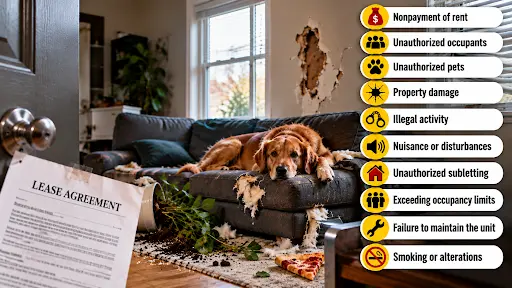
Most lease violations fall into a few recurring categories. Here's what shows up most often in practice.
Nonpayment of rent. This is the most common violation by far, and Illinois law treats it distinctly from other lease breaches. It gets its own notice period and its own filing category in eviction court.
Unauthorized occupants. When someone moves in who isn't on the lease, that's a violation of the occupancy terms, and it can also create liability and insurance problems for the owner.
Unauthorized pets. If your lease prohibits pets or requires pet approval and a tenant brings one in anyway, that's a straightforward breach.
Property damage beyond normal wear and tear. Illinois law distinguishes between ordinary wear from daily living and actual damage caused by neglect or misuse. Only the latter is a violation.
Illegal activity on the premises. Drug activity, criminal conduct, or anything else that violates the law itself is almost always treated as a serious, sometimes immediate, violation.
Nuisance or disturbing other tenants. Excessive noise, harassment of neighbors, or ongoing disruptive behavior can breach the lease's quiet enjoyment clause.
Unauthorized subletting. If a tenant hands their unit off to someone else without your approval, that violates the assignment and subletting terms most leases include.
Exceeding occupancy limits. Local building and housing codes set maximum occupancy per unit, and leases typically mirror those limits.
Failure to maintain the unit or allow access for repairs. Tenants have obligations too, and refusing reasonable access for maintenance or letting the unit fall into disrepair through negligence can be a violation on their end.
Smoking or alteration violations. If your lease designates the property smoke free or prohibits structural changes without approval, breaking either of those counts.
Why Local Ordinances Change the Picture
This is where things get complicated for landlords who manage across multiple municipalities. Illinois state law sets the floor, but home rule municipalities can build additional tenant protections on top of it. Chicago has the Residential Landlord and Tenant Ordinance, known as the RLTO. Suburban Cook County has its own Residential Tenant Landlord Ordinance, the RTLO, which applies to unincorporated areas and any municipality that has adopted it. Beyond those two, individual towns like Oak Park and Evanston have written their own local ordinances that layer even more requirements on top.
These local rules can affect notice periods, security deposit handling, fee limits, and what counts as retaliatory or discriminatory action by a landlord. When a local ordinance conflicts with general state law, the local ordinance typically governs within its jurisdiction because it was written to give tenants more protection, not less. Practically, that means the same lease violation can play out differently depending on whether the property sits in the city, unincorporated Cook County, or a suburb with its own ordinance. We manage properties across more than 100 municipalities, and checking which ordinance applies to a specific address is one of the first things we do before sending any notice.
How Notice Requirements Work
Illinois splits notice periods by violation type. Nonpayment of rent generally requires a 5 day notice giving the tenant a chance to pay before an eviction filing proceeds. Most other curable lease violations require a 10 day notice, giving the tenant time to fix the issue. Some violations, particularly ones involving illegal activity or serious safety threats, allow a landlord to proceed without giving the tenant a chance to cure at all. Getting the notice type and timeline wrong is one of the most common reasons an otherwise valid eviction case gets thrown out or delayed.
FAQ
Does every lease violation lead to eviction?
No. Many violations are handled through a warning or a chance to cure the issue. Eviction is typically reserved for violations that go unresolved or that fall into more serious categories like nonpayment or illegal activity.
Can a landlord add violation terms beyond what state law covers?
Yes, as long as those terms don't conflict with state or local law. Most of what ends up in a lease, pet policies, guest limits, alteration rules, comes from the landlord's own terms rather than statute.
What happens if a local ordinance and state law disagree?
The more tenant protective rule usually applies within that jurisdiction. This is why the same violation can be handled differently in Chicago versus unincorporated Cook County versus a suburb like Oak Park.
Don't Go At This Alone!
Illinois lease law isn't one clean rulebook, it's state statute, your own lease terms, and whichever local ordinance applies to that specific address, all working together. Getting any one of those wrong can cost you a case in court. At GC Realty & Development, we manage close to 1,500 units across more than 100 municipalities, which means we deal with this overlap of state and local rules every single day. My mission has always been the same, help investors keep more of what they earn and lose less sleep doing it. If you'd rather have someone who already knows which ordinance applies to your property, that's exactly what we're here for.
Related Reading
The Eviction Process in Illinois, A Step by Step Guide for Landlords (2026)
RLTO Lease Packet Requirements, What Chicago Landlords Must Include