

 Vendor Portal

Author: Mark Ainely | Partner GC Realty & Development & Co-Host Straight Up Chicago Investor Podcast
We handle close to 500 lease transactions a year across about 1,500 units in Chicagoland, and every one of them starts with screening. Credit is usually the first thing an owner asks about. It shows how an applicant handles their obligations, whether there are collections or a prior landlord judgment, and whether the rent fits on top of what they already owe each month.
Pulling the report is easy. Pulling it the right way in Illinois takes more thought. Two rules catch landlords more than anything else.
First, applicants can bring their own screening report, and if it meets the state standard you cannot charge them a screening fee. Second, if the property is in Cook County, you cannot run credit and criminal background at the same time. A lot of screening companies sell that as one package by default, and that default is exactly how landlords end up in violation of the Just Housing Amendment.
Key Takeaways
- Since January 1, 2025, Illinois law lets applicants hand you a reusable tenant screening report. If it meets four criteria, you cannot charge them an application screening fee.
- You can still run your own report on top of theirs, as long as the applicant does not pay a screening fee for it.
- In Cook County, the Just Housing Amendment requires a two step process. Credit, income, and rental history come first. Criminal background comes second, and only after the applicant prequalifies.
- Many screening platforms bundle credit and criminal into one order. In Cook County, ordering them together can put you out of compliance even if you never read the criminal section.
- Fair housing testers request copies of their reports and compare the time stamps. Same time stamp, same violation.
- Application fraud is increasingly built with AI, so your screening should use AI tools to catch it.
- Write down your screening criteria, apply them to every applicant the same way, and keep records of each step.
What a Tenant Credit Check Actually Tells You
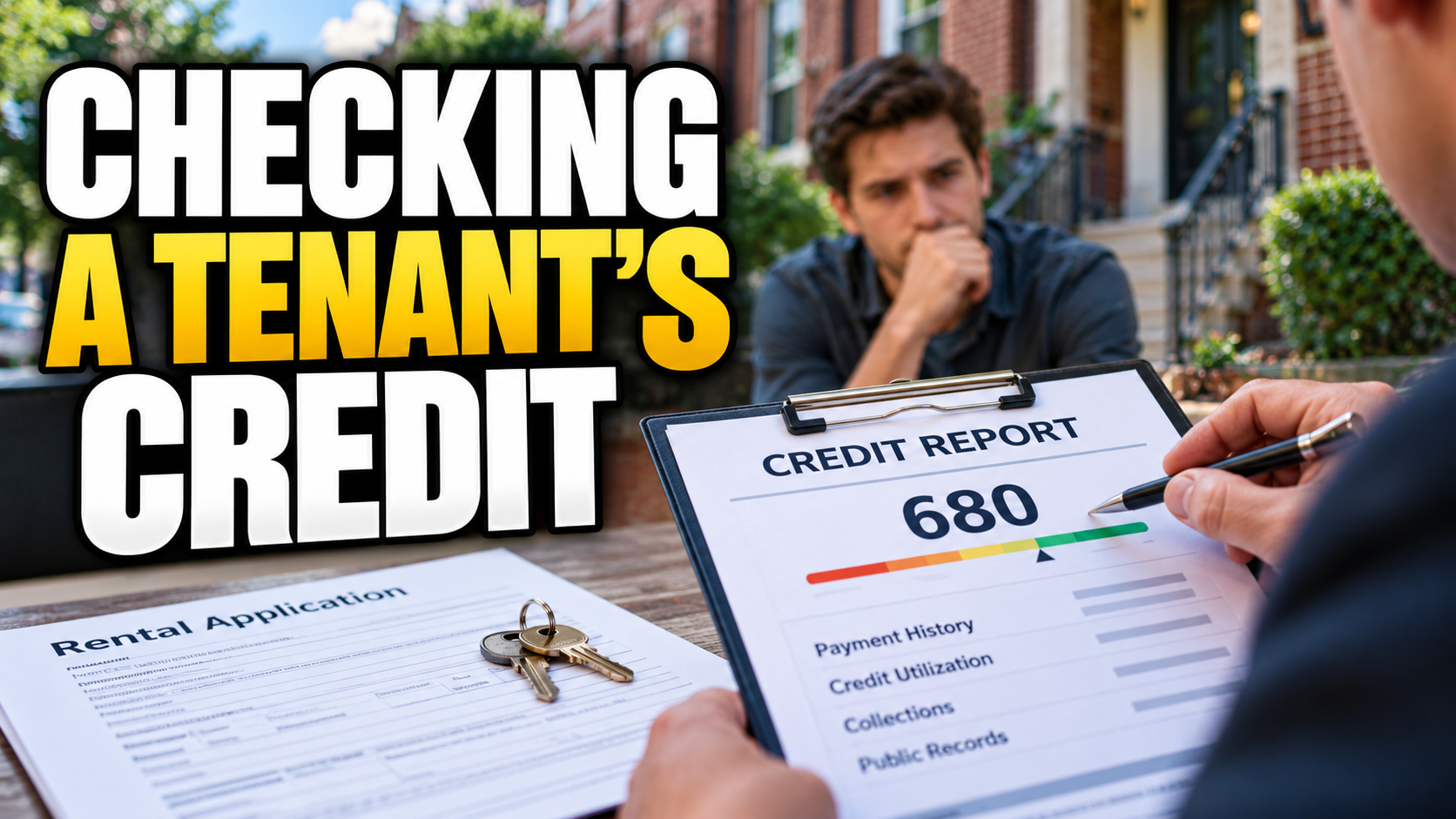
A credit report is a history of how someone pays what they owe. Owners tend to fixate on the score, but for us the score is one factor out of a couple dozen we weigh on every application. The real value is the detail underneath it.
Here is what our team actually pulls out of a report.
- Debt ratios. Car payments, student loans, and minimum card payments all compete with rent. Strong income can still be stretched thin once you add up what is already going out each month.
- How close they run to their limits. An applicant who keeps every card near the max is telling you how they handle money when things get tight.
- Employers and previous addresses. The report lists both, and they should match what the applicant put on the application. When they don't, that is a conversation worth having before you go any further.
- Bankruptcies, collections, and bad debt. These show up plainly on the report. Timing and what has happened since are part of the picture.
- Anything owed to a prior landlord. For us, a collection or judgment from a previous landlord within our lookback period is an immediate decline, unless the applicant can show proof of a special circumstance that explains it.
Before you pull anything, get written authorization from the applicant. Federal law under the Fair Credit Reporting Act requires a permissible purpose to pull a consumer report, and screening companies will require the applicant's consent. If you deny an applicant or approve them on worse terms because of something in the report, the FCRA also requires you to send an adverse action notice that names the reporting company and explains the applicant's right to dispute.
The most important piece is consistency. Decide your minimum standards before you list the unit, put them in writing, and apply them the same way to every applicant. That protects you under fair housing law, and as you will see next, it also matters for the reusable report rule.
Tenants Can Bring Their Own Screening Report
Public Act 103 0840 added Section 25 to the Illinois Landlord and Tenant Act (765 ILCS 705/25), effective January 1, 2025. It created the reusable tenant screening report. The idea is simple. An applicant pays for one report and uses it for every unit they apply to, instead of paying a new screening fee each time.
Under the statute, the report has to come from a consumer credit reporting agency, state the date through which the information is current, and include at least the applicant's name, contact information, income source verification, last known address, and eviction history results.
If an applicant gives you a report that checks all four of these boxes, you cannot charge them an application screening fee or a fee to access the report.
1.It was prepared within the last 30 days, at the applicant's request and expense.
2.It was made directly available to you, or provided through a third party website that is in the business of reusable reports and follows state and federal consumer report law.
3.It costs you nothing to access or use.
4.It includes every criterion you consistently use to screen applicants.
That fourth point is where landlords should pay attention. Credit is not on the statute's list of required contents. So if you screen on credit and the applicant's report does not include it, the report does not meet the standard. This is why having your criteria in writing matters. You cannot measure their report against a standard you never defined.
There are some situations where a partial screening fee can still be charged, but those exceptions depend on the details of your criteria and the report in front of you, so we won't get into them here. If you are unsure, talk to your attorney before you charge anything.
A few other things the law allows.
- You may require the applicant to state that nothing material has changed since the report was prepared.
- You may still collect and process your own application and run your own report, as long as the applicant is not charged a screening fee for it.
- If a local ordinance gives applicants stronger protections, the local rule applies.
Honestly, it is rare. Out of close to 500 lease transactions a year, we see very few applicants show up with a reusable report. That is exactly why landlords get caught off guard. When one finally lands in your inbox, you need to already know what to do with it.
When we wrote about this law before it took effect, our biggest concern was legitimacy, and that has not changed. Today that worry is bigger, because AI tools make it easy to produce an altered report that looks completely real. The answer is to use AI fraud detection on your end too, alongside a few basic habits.
- Get the report from the source. The statute requires the report to come directly from the reporting agency or through a qualified third party website. A PDF the applicant emails you is not the same thing.
- Name what you accept. Spell out in your application materials which reporting agencies and platforms you accept and the 30 day window.
- Verify identity and details. Cross check the name, address history, and employers against the application and the applicant's ID.
- Train whoever touches applications. Your leasing team should know how to check a reusable report against your criteria quickly, so it doesn't sit while a qualified applicant moves on to another unit.
In Cook County, Credit and Background Must Be Kept Separate
In April 2019, the Cook County Board approved the Just Housing Amendment to the county's Human Rights Ordinance, and enforcement began February 1, 2020. It applies to rental housing located in Cook County, and it changed the order in which landlords are allowed to screen.
We cover the full rules, who they apply to, and what happens when landlords ignore them in our Chicago Just Housing Amendment guide. Below is what matters for running a credit check.
The county lays out the process in its screening guide.
Step one is prequalification. You review credit history, employment, income, payment history, bankruptcies, rental references, and your other written criteria. No criminal background check can be run during this step.
Step two is the criminal background check. Only after the applicant meets your prequalification standards can you move forward, and you must notify the applicant that they passed step one and that a criminal background check will be performed.
Once you get to step two, more rules apply.
- You can only consider convictions from the last three years. Anything older cannot be used to deny the application.
- If the check shows a conviction within that window, you must do an individualized assessment that looks at things like the nature and severity of the offense, how long ago it happened, and evidence of rehabilitation.
- Within five business days of receiving the check, you must give the applicant a copy of it. The applicant then has five business days to respond with evidence that the record is inaccurate or with mitigating information.
- Your application cannot include a checkbox asking whether the applicant has a criminal background.
- One point that surprises owners is that the amendment does not require you to run a criminal check at all, according to the county's own evaluation report. It only controls how and when you do it if you choose to.
Where Landlords Get in Trouble With Bundled Screening
Most national screening companies were built for speed. You send the applicant one link, they pay one fee, and a single report comes back with credit, eviction history, and criminal background all together. Outside Cook County, that works fine. Inside Cook County, it breaks the two step rule.
The problem is not only what you read. It is what you ordered. If the criminal search runs at the same moment as the credit pull, the background check was performed during prequalification. Telling yourself you only looked at the credit page does not fix that, and it is a hard position to defend if an applicant files a complaint with the Cook County Commission on Human Rights.
The real risk is not an applicant who happens to notice. It is a tester. Fair housing testers and secret shoppers apply for units specifically to check whether landlords follow the rules. After they apply, they request copies of their credit and background reports and look at the time stamps showing when each one was requested. If the credit pull and the criminal search carry the same date and time, there is your violation, sitting right on paper. You will not know a tester applied until the complaint shows up.
Most screening platforms now recognize local laws like the Just Housing Amendment. In 2022, the county announced that TransUnion SmartMove had built the two step process into its tool. But we still hear that some of the big platforms do not handle it correctly. Do not assume a platform understands Cook County law just because it is a name you recognize. Some only split the order if you choose the right setting for the property, and some do not split it at all.
Here is what we recommend for any Cook County unit.
- Check your screening platform for a Cook County or two step setting and confirm it is turned on for every Cook County property.
- If your platform cannot split the order, run credit, income, and rental history first, then order the criminal check separately after prequalification.
- Remove any criminal history question from your rental application.
- Send the prequalification notice in writing so you have a record of when step one ended and step two began.
- If you manage in both Cook and the collar counties, do not use one screening setup for everything. Set the process by property location.
How to Run a Credit Check on a Tenant in Illinois, Step by Step
This is the order our leasing team follows. If the property is outside Cook County, steps 6 and 7 can be combined with your normal screening, but the rest still applies.
1.Write your screening criteria before you list. Minimum income, credit standards, rental history, and anything else you will screen on. Apply it the same way to every applicant.
2.Get signed authorization. The applicant should consent in writing before any consumer report is pulled.
3.Ask if they have a reusable screening report. If they do, check it against the four statutory criteria and your written standards. If it qualifies, do not charge a screening fee.
4.Run credit, income, and rental history. In Cook County, this is step one. Nothing criminal is ordered yet.
5.Make the prequalification decision. If you deny or change terms based on the credit report, send an FCRA adverse action notice.
6.Cook County only, send the prequalification notice. Tell the applicant in writing that they passed step one and that a criminal background check will be run.
7.Run the criminal check and follow the JHA rules. Three year lookback, individualized assessment if a conviction appears, a copy to the applicant within five business days, and five business days for them to respond.
8.Document everything. Keep the criteria, authorization, reports, notices, and your decision in the applicant file. If you are ever asked why someone was approved or denied, that file is your answer.
Common Mistakes Landlords Make With Credit Checks
- Screening by eye in an AI world. Application fraud is common, and these days most of it is built with AI tools. Altered credit reports, fake pay stubs, and edited bank statements can look perfect to the naked eye. If fraudsters are using AI to create documents, your screening process should be using AI tools to catch them.
- Accepting a screenshot or emailed PDF as a credit report. A score from a free credit app or a file the applicant sends you is not a consumer report. Get it from the reporting agency or a qualified platform.
- Screening voucher holders on the full rent. Illinois protects source of income. Applying your income requirement to the full contract rent instead of the tenant's portion is one of the most common ways landlords end up with a fair housing complaint.
- Skipping the adverse action notice. If something in the report led to a denial or worse terms, the FCRA requires a notice. Plenty of small landlords never send one.
- Bending the standards for someone you like. Waiving the credit minimum for one applicant and holding the line on the next is how inconsistency turns into a discrimination claim.
- Trusting the platform to know local law. A recognizable brand does not mean the default settings follow Cook County rules. Check them yourself.
Frequently Asked Questions
Can I run my own credit check if the tenant brings a reusable report?
Yes. Illinois law allows you to collect your own application and run your own report in addition to theirs. You just cannot charge the applicant a screening fee for it when their report meets the statutory criteria.
How old can a reusable tenant screening report be?
It must have been prepared within the last 30 days. You can also require the applicant to state that nothing material has changed since then.
Does the reusable report have to include a credit check?
The statute does not list credit as a required item. But for the fee ban to apply, the report must include every criterion you consistently use. If credit is one of your criteria and their report leaves it out, it does not qualify.
Does the Just Housing Amendment apply outside Chicago?
Yes. It is a Cook County ordinance and applies to rental housing located in Cook County, including the suburbs. It does not apply in DuPage, Kane, Will, Lake, or McHenry County, though local rules there can still apply.
Do I have to run a criminal background check in Cook County?
No. The amendment does not require one. It controls the timing and the process if you choose to run one.
What credit score should I require?
There is no number set by law. We care more about rental and utility collections, total monthly debt, and recent payment history than a single score. Whatever standard you pick, put it in writing and apply it to everyone.
Don't Go At This Alone!
Screening looks simple until you are dealing with a reusable report you have never seen before, a platform that bundles everything by default, and a Cook County applicant waiting on your prequalification notice. Our leasing team runs this process every day across about 1,500 units in more than 100 municipalities, with separate workflows for Cook County and the collar counties. We know which rules apply where, and we document every step so our owners are protected.
[Mark's mission statement]
Related resources
%20(3)%20(1)_3.png)
_1.png)